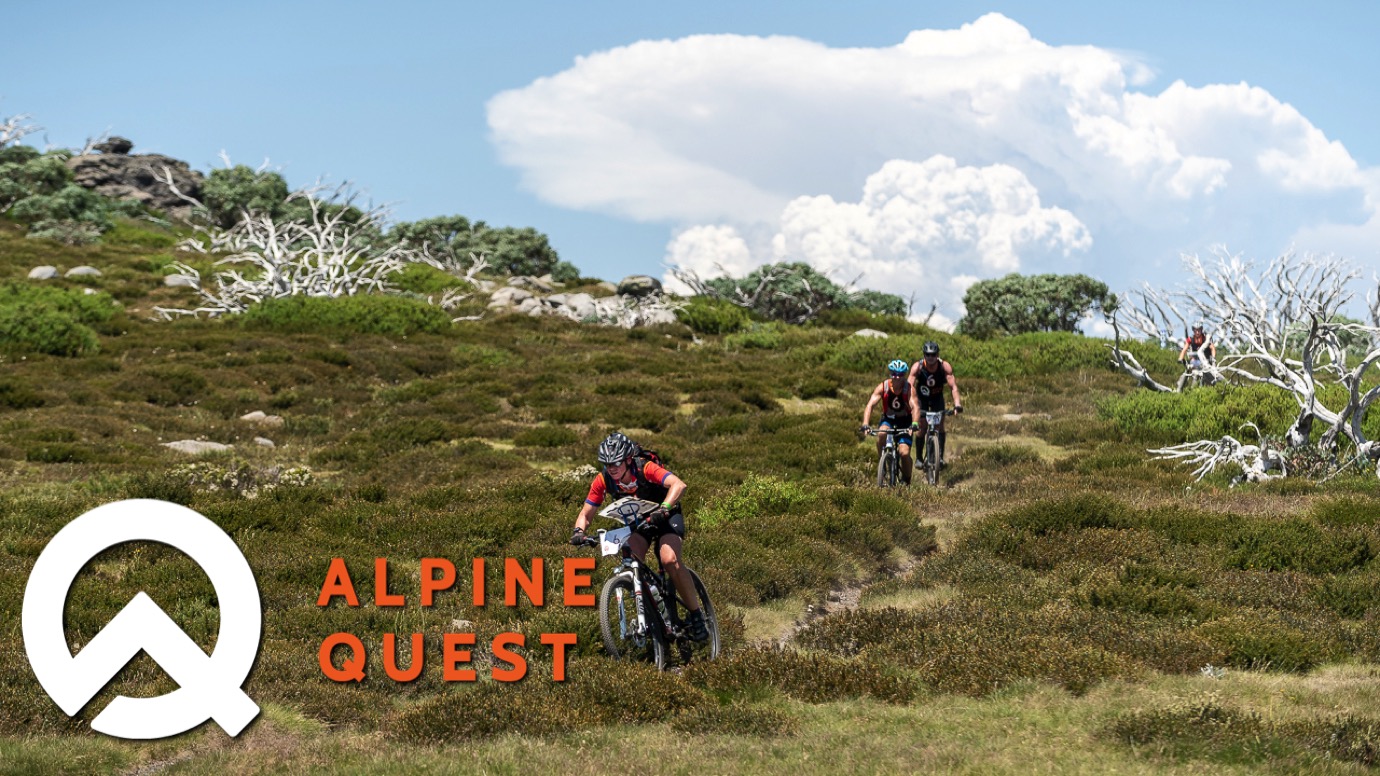
The Expedition
There are races, and then there are journeys that change you. Alpine Quest is the second kind.
Alpine Quest is a multi-day, expedition-length adventure race held in the Australian High Country, in the Kosciuszko region of the Snowy Mountains. It is the most demanding event in the Adventure Junkie portfolio — one continuous line across the highest, wildest country there is, raced non-stop, day and night, until the finish. No stages reset overnight. No easy days. Just you, your team, and the mountains, for as long as it takes.
"You'll finish Alpine Quest and never look at a mountain the same way again. It strips you back to the essentials — your team, your map, the terrain — and shows you what you're actually capable of."
- Sergey Kurov / Race director
“Push yourself to your limits, learn about yourself and how to effectively work together as a team whilst enjoying some of the most spectacular, rugged, and untouched areas of the country.”
- Steve Owens, race participant (Melbourne)
Alpine Quest returns in 2027.
One Line, Start to Finish
Alpine Quest is a linear, point-to-point course. Teams are bussed to a remote start, and from the moment the race begins there is only one direction — forward, to a finish that must be earned kilometre by kilometre. Every leg is new ground. Nothing is retraced.
The race is built on the classic disciplines of expedition adventure racing — trekking, mountain biking and paddling, linked by navigation that never stops. Teams move entirely under their own power, day and night, making their own decisions about route, pace, rest and sleep. Time never stops.
Other disciplines and surprises may be added at the organisers' discretion — a swim, an abseil, a strategic decision that splits the field — and teams may or may not be told about them before the start. That's the nature of expedition racing.
Race Self-Sufficient. Race Equal.
Alpine Quest is run without private support crews. Instead, the race organisation and its volunteers transport every team's gear between transitions — so there are no crews to manage, no vehicles to coordinate, and no advantage to the teams with the deepest pockets. Every team arrives at every transition on exactly the same terms.
Teams pre-pack their gear boxes, which are carried to the transition areas (TAs) staffed by race officials and volunteers. At each TA teams change discipline, swap gear and restock for the next stage. Between transitions, teams are entirely self-sufficient.
This is the sport stripped back to what truly matters: your fitness, your skills, your navigation and your teamwork. Nothing else decides it.
How the Race Works
- Teams receive the logistics matrix about two weeks before the race, so they know what to pack in each gear box and where it will be.
- Maps and race information are handed out shortly before the start.
- The course is broken into stages, linked by transition areas and a series of mandatory checkpoints.
- To finish ranked, teams must race from start to finish as a complete team of four, passing through every transition area on their course. Teams on the short course remain ranked, and may skip only the transition areas that are not part of the short course.
- Every mandatory checkpoint missed adds a time penalty to the team's time.
- Optional checkpoints earn a time bonus, taken off the team's time. Is the detour worth it? That's your call.
- Between checkpoints the route is generally your choice — which is where the real navigational challenge lives.
Time on Course
Teams have 5.5 days to finish, with the fastest expected to complete in around 3.5 to 4 days of near-continuous racing. A mid-race cut-off and short course will shorten the route for teams who need it, so everyone reaches the finish within the time allowed. Teams on the short course are still ranked. Exact distances, stage breakdown and cut-off times will be confirmed in the race information released ahead of the event.
Maps Made by Racers, for a Fair Race
We are racers ourselves, and we know that a great adventure race is won by skill — not luck. So we make our own maps, and we make them properly.
Drawing on every source of open data available to us, we produce a purpose-built suite of cartography at multiple scales: broad-scale sheets for covering big country at speed, detailed large-scale maps for the technical sections where precise navigation decides everything, and dedicated water maps where the route runs to the rivers. Strong navigators will be rewarded. The course will push your route choice and your map skills to the limit — but it will always be a fair contest, never a lottery.
Midcamp: Race Hard, Race Safe
Somewhere out on the course, every team must stop. Alpine Quest features a midcamp with a mandatory rest, where teams have access to their own tent and sleeping bag — a chance to eat, sleep, dry out and reset before pushing on.
It is a strategic gift and a safety net in one. It keeps the field racing sharp rather than dangerously sleep-deprived, and it ensures the hardest decisions on course are made by rested minds. How you use your time at midcamp is up to you. That you take it is not.
The Mountains Don't Negotiate
This is demanding terrain, technically and physically, and the weather here writes its own rules. Teams must be ready for everything the high country can throw at them — temperatures ranging from well below zero to the high thirties, long stretches on and in the water, and the genuine possibility of snow on the highest ground, even in the racing season.
A high degree of outdoor competency is a prerequisite of entry. Teams should not underestimate the importance of being well prepared for travel in remote, exposed terrain.
Preparation is not optional. The teams who respect the conditions, pack smart and look after one another are the teams who reach the finish.
Watched Over, Every Step
An adventure of this scale demands a serious approach to safety, and Alpine Quest takes it seriously. Every team carries a satellite phone and a live GPS tracker, so the race organisation knows where you are at all times and help can reach you wherever you are on course. Your family at home can follow your progress in real time too. You will be out in genuinely wild country — but you will never be off the grid.
Can You Do It?
Alpine Quest tests far more than fitness. It rewards preparation, navigation, teamwork, judgement and the kind of quiet resilience that only shows up at 2am on a high ridgeline in the cold — the mental strength to keep moving when conditions turn and the body wants to stop. Cross that finish line, and you will carry it for the rest of your life.
The mountains don't make it easy. That's exactly why you'll never forget it.
Alpine Quest. The Roof of Australia awaits.